Orbit Dash
5
Orbit Dash is a fast, reflex-driven arcade where players hook, swing, and launch through shifting tracks, vibrant skins, and rising speed in a tense space rush.
Orbit Dash — sometimes called Orbit Dashes, Orbit Racer, or even Planet Dash game — plays like a quick pulse through a neon tunnel. The moment the orb begins to move, the whole world feels like a taut string waiting to snap. Many players jump in for a short break, only to find themselves racing around orbit after orbit, drawn in by that familiar mix of tension and flow. Among unblocked reflex titles, it stands out as a sharp, minimal, but surprisingly expressive Orbiting Dash game.
The HTML5 web edition by Yoplay.io keeps everything sleek. Endless, single-lane at first glance, but shifting as the run unfolds. The premise may be simple, though the game itself refuses to behave that way. That contrast is its charm.
The player guides a small glowing orb, moving forward like a comet locked to a path. As it nears an anchor point, a press hooks the orb into a circular swing. Hold, feel the curve tighten, then release. The dash shoots outward, using built-up momentum. Miss the timing, hit a wall, clip a corner, or take a spiral at the wrong angle — run over.
One tap to hook. One release to launch. A tiny rhythm, but a rhythm with teeth.
Tracks come in multiple forms: straight lanes that feel like narrow runways, or curled, twisting lanes that resemble spirals pulled from a spirograph toy. Some runs switch between both, forcing the player to re-learn their sense of angle mid-flight. The terrain’s look also shifts — sometimes a full-blue route, sometimes three-colour paths in yellow, blue, and pink. It feels as if the world is breathing under the orb’s speed.
The endless runner game stays visually clear, though it never lets the mind drift into comfort. Every hook turns into a split-second wager between instinct and control.
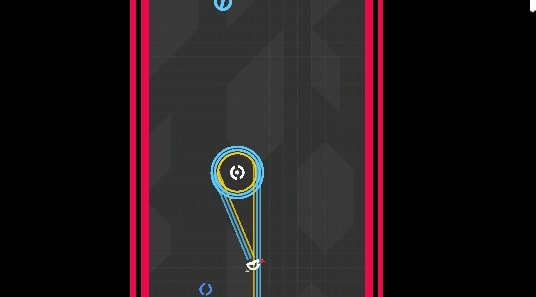
The track will change colour from grey to red when the arrow passes through in the Orbit Dash game.
Many speed games telegraph their difficulty. Orbit Dash does not warn; it accelerates with subtlety. One moment, the orb glides lazily; the next, it snaps forward like an impatient star. This creeping pace forces the skill gamer to adjust, to treat every anchor like a new puzzle. The shift from calm to urgent gives the run a cinematic heartbeat.
The game includes multiple arrow skins — sharp neon arrows, rounded comet-trail styles, even minimal dots that leave a soft trace. They behave the same mechanically, yet they change the personality of a run. Combine that with lane colours that alternate between tri-colour stripes or uniform blue, plus straight or spiral tracks, and the result is a run that always looks fresh even without altering its core structure. Small aesthetics, big psychological effect.
The hook-and-swing mechanic is the spine of the Orbit Dash arcade style. A good release feels like launching a slingshot; a bad release feels like slipping on wet glass. When the arc widens at high speed, a single half-second decides if the orb threads the needle or crashes. The tension resembles watching a marble roll around the rim of a bowl — unpredictable but beautiful.
Treat each anchor as a pivot rather than a target. A small delay on the release often gives a cleaner line. On spiral tracks, release slightly earlier than instinct suggests; tight curves punish late actions. Straight lanes allow longer holds but require sharper angle judgment.
When speed increases, shorten your mental rhythm. Avoid stacking wide orbits. Deep loops look stylish but break precision.
Finally, pick a skin that contrasts well with the background. High visibility helps the eye find the arc faster, especially in 3D game perspectives where the illusion of depth becomes stronger.
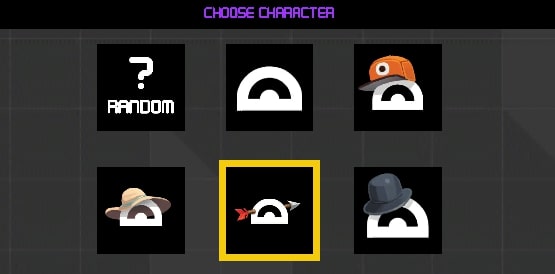
Arrow skins in the Orbit Dash game
Tiny Fishing is calm by design — low pressure, steady clicks, a loop built around patience. Orbit Dash is the opposite: a sprint, not a sit-down session. Tiny Fishing rewards endurance; Orbit Dash rewards instinct.
Wave Road has a lot in common with Orbit Dash. Both rely on rhythm and lane management. But Wave Road flows like water, bending softly, letting players surf. This quick reflex game is steel-wire — tight, reactive, unforgiving. One bends; one snaps. That difference defines their audiences. Wave Road is meditation. Orbit Dash's challenging modes are adrenaline.
Play Orbit Dash once, and it feels like a small arcade experiment. Play it twice, and it becomes a race against reflexes. Play it three times and the mind begins to anticipate arcs before they happen, like reading the path of a planet before it swings around a star.
For players craving a fast, stripped-down Orbital Race with a touch of style, this is easily one of the best game experiences on the browser. It’s short-form, sharp, and endlessly repeatable — a Race Around Orbit crafted for quick bursts of focus.
If these endless running games appeal to you, why not check out Yoplay? You can find a whole host of other engaging titles waiting for you over at: https://yoplay.io/.
Yes, many styles exist to change the visual feel without altering mechanics.
Yes, scoring is based on distance and survival.
The core is simple, but timing becomes demanding as speed rises.